
Sound is an important part of the natural world. Children hear sounds everywhere around them: birds singing, rain falling, leaves moving in the wind, footsteps, water flowing, or insects buzzing. These sounds help children observe, explore, and understand their environment.
In science education, sound-based activities encourage curiosity and active learning. Children become more attentive to details when they listen carefully to the world around them. Through listening and observation, they begin asking questions, making connections, and describing what they experience.
You can use sound to introduce scientific thinking in playful and meaningful ways. Young children learn science best when they explore with their senses. Listening activities support observation, attention, memory, communication, and critical thinking.
Listening to nature
Nature provides rich opportunities for sound exploration. Outdoor listening activities help children become more aware of environmental sounds and changes in their surroundings.
You can organise a simple “sound walk” in the school garden, playground, or nearby park. During the activity, children stop, listen quietly, and identify different sounds.
For example, children may hear:
- birds,
- wind,
- rain,
- insects,
- leaves,
- footsteps,
- distant traffic,
After listening, encourage children to describe the sounds.
You can ask:
- Was the sound loud or quiet?
- Was it near or far away?
- Was it natural or human-made?
- How did the sound make you feel?
These questions support observation skills and scientific vocabulary.
Sound and scientific observation
Listening carefully teaches children how to observe patterns and changes. For example, children may notice that birds sound different in the morning than in the afternoon, or that rain creates different sounds depending on intensity.
You can connect sound activities with simple science topics such as:
- weather,
- seasons,
- animals,
- habitats,
- recycling,
- water,
Children can compare sounds, sort sounds into categories, or investigate how sounds change in different environments.
For example:
- Which materials create louder sounds?
- Which sounds belong to nature?
- Which sounds are soft or sharp?
- How does sound change indoors and outdoors?
These activities encourage prediction, experimentation, and discussion.
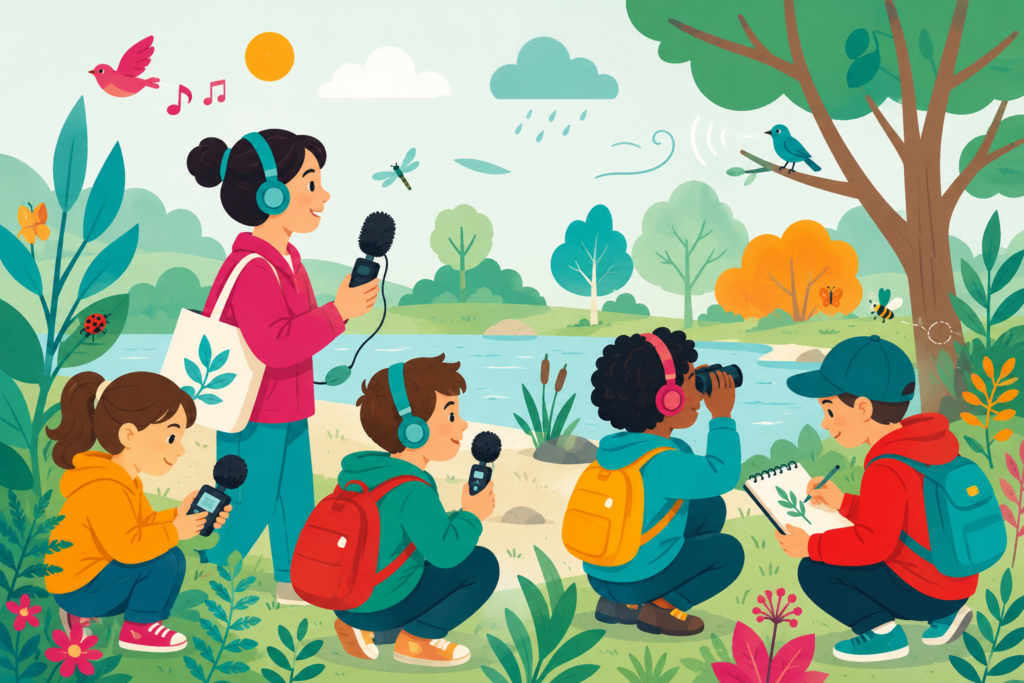
A playful outdoor learning experience: children explore nature recording the sounds around them. Generated image with AI.
Recording and analysing sounds
Simple recording activities can make science learning more interactive. Children can use tablets or voice recorders to capture environmental sounds and replay them later in the classroom.
You can create a “class sound collection” with:
- nature sounds,
- weather sounds,
- classroom sounds,
- animal sounds.
Children can then:
- classify sounds,
- draw what they hear,
- create sound maps,
- connect sounds with scientific concepts.
This process strengthens listening attention, memory, and communication.
Inclusive science learning through sound
Sound-based science activities support inclusive education because they allow children to learn through multiple senses.
Children with Specific Learning Difficulties (SLDs), attention difficulties, speech and language needs, or different learning styles may benefit from hands-on and multisensory experiences.
You can support inclusion by:
- combining sound with visuals,
- allowing movement during activities,
- repeating recordings,
- using simple instructions,
- encouraging collaborative exploration.
Sound exploration also creates opportunities for emotional connection with nature and the environment. Children become more aware of their surroundings and develop curiosity about the world.
You do not need advanced technology or scientific equipment to introduce sound-based science activities. Simple listening, recording, and observation tasks can already transform science learning into an engaging and meaningful experience.
By using sound creatively, you help children observe more carefully, communicate more confidently, and explore science through curiosity and imagination.
Learning goal
Develop listening attention, scientific observation, environmental awareness, vocabulary, and sound recognition skills.
Listen carefully to the sounds around you, identify where they come from, and classify them into animal, object, mechanical, musical instrument, environment, or speech sounds.
Key outcomes
- Understand how sound supports scientific observation and exploration.
- Explore practical sound-based science activities for children with Specific Learning Difficulties (SLDs) .
- Develop children’s listening attention and environmental awareness.
- Recognise the value of multisensory and inclusive science learning.
- Gain ideas for connecting sound with nature and environmental education.
Resources
- Kraus, N., & Slater, J. (2015). Music and language: relations and disconnections. Handbook of clinical neurology, 129, 207-222.
- Cumming, R., Wilson, A., Leong, V., Colling, L. J., & Goswami, U. (2015). Awareness of rhythm patterns in speech and music in children with specific language impairments. Frontiers in human neuroscience, 9, 672.
- Chawla, L. (2015). Benefits of nature contact for children. Journal of planning literature, 30(4), 433-452.


