

When preparing to create this course, one of the team members shared a personal story: ‘As a child, I loved stories – those read by parents and those I listened to just before bedtime. They were on vinyl records, and each evening I could choose which story I wanted to hear today. The one I chose most often was »Smurfs«’. Means have changed – from vinyl records, through cassette tapes and CDs, we have arrived at a point where stories are available on our phones. But one thing remains unchanged. Children love listening to stories, especially those they already know. They hear stories in (pre)school, read by the teacher; at home, read by their parents; and, more and more often, as audiobooks. But the latter doesn’t mean the human and educational aspects disappear.
Audiobooks as bond builders
Imagine a parent spending a lot of time away from home, temporarily separated from their kids. A prisoner, for example. By recording a story and sharing it with their offspring, they can sustain, or even strengthen, the bonds between them. This initiative, called Storybook Dads, was launched in a UK prison. Its success led to the programme covering over 100 UK prisons and to the transfer of that idea not only to other countries but also to the British Army, Navy and Air Force. And of course, there’s a Storybook Mum version as well. On the mutual (grand)child–(grand)parent impact the project has – also on literacy – you can read on the Story Dads Foundation website.
Transmedia and emotions
Nowadays, one character appears in various media: cartoons, TV series, video games, audiobooks, paper books, and so on. So if a child loves a pig family, pony/unicorn adventures or dogs saving the world, you can build on that. Use those children’s interests to motivate them to read on their own. Because storytelling is also about emotions, which can influence kids’ empathy. You’ve probably noticed how very passionate they are when talking about story characters. They have their favourite ones, with whom they sympathise or even identify. As a teacher, educator, or simply a parent, you can encourage children to read, especially at this early, very challenging stage.
Professional voices
“Hearing stories read by professional readers demonstrates the rhythm, tone and pronunciation of a narrative, which can help children develop their own understanding of reading behaviours”. [1] This means that by listening to actors and narrators, children hear how one can change one’s voice depending on the situation – raise it when angry, lower it when sad. Story characters may have different accents or characteristic voices – hoarse or squeaky. They may stutter or lisp. Each character’s characteristics include their vocabulary. The diverse words and expressions they use build children’s vocabulary, teach them to pronounce words correctly and set words in proper context.
Sounds for literacy
As children, we might not notice it, but by ages 8–10, we learn a lot about the sounds of spoken language: we recognise similar phones (e.g. words beginning with the sound ‘m’); we break sentences into words and words into syllables; we match the words that rhyme. And we learn all that through play: singing songs, memorising simple poems that rhyme, repeating words over and over again, creating our own words, and asking ‘What is that?’ thousands of times, only to hear the same answer every time.
These simple activities build children’s awareness of sounds. The ability to identify sounds will be priceless when they have to match them to letters as they begin to read.
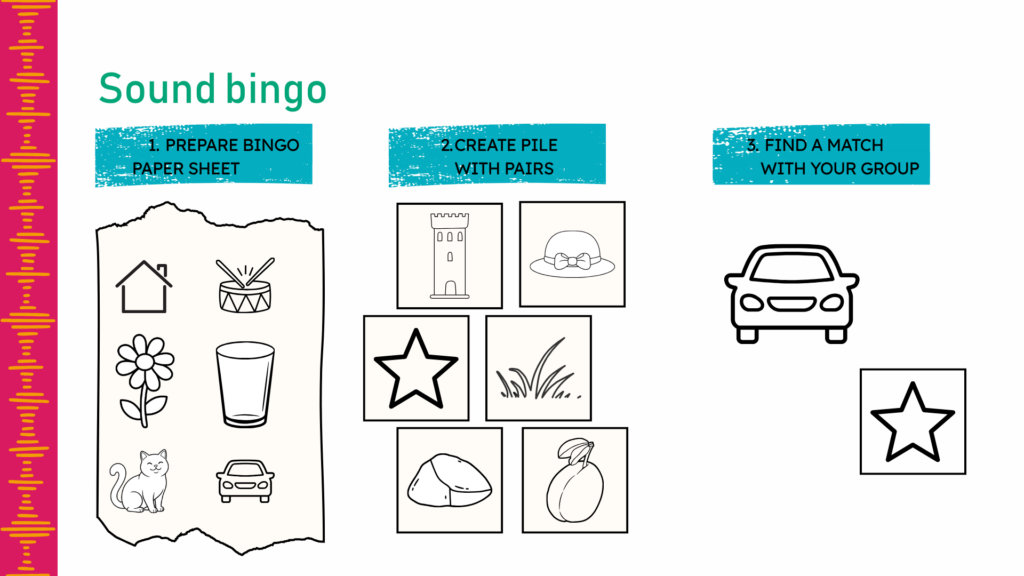
We already provided you with ideas on how to use sounds in teaching in Lesson 1 of Module 2: Sound-based learning approaches. Here we wanted to share one more way you can help kids master the art of sound awareness: a rhyme bingo. You will need two things: a printed sheet with pictures of different objects and a pile of cards representing another set of objects. Each of them has to have their rhyme match on a printed handout. A child draws an object from the pile and has to find a rhyme match.[2]
As a child, you simply enjoyed stories, poems and spontaneous play. Now, as an adult, you know how much that “simple” storytelling helps kids to develop their literacy skills.
Key outcomes
- Children engage with stories across many formats – from live reading to audiobooks – and each offers unique literacy and developmental benefits.
- Audiobooks can strengthen emotional bonds between children and absent caregivers, as shown by initiatives like Storybook Dads, while supporting literacy at the same time.
- Professional narrators model rhythm, tone, pronunciation and vocabulary, helping children develop a richer understanding of spoken and written language.
- Everyday sound play – rhyming, singing, and syllable games – builds phonological awareness that is essential when children begin to match sounds to letters.
Resources
Footnotes
- [1] E. Best, Playful storytelling. The role of interactive audio in building children’s literacy skills and engagement, 2021, accessed on 11 May 2026.
- [2] We provide you with this example after the article Phonological and Phonemic Awareness: Activities for Your Pre-K Child, n.d., accessed on 11 May 2026. On the same website, you’ll find ready-to-use, printable materials you can use in your classroom, including the rhyme bingo. Many of them are accompanied by a short video showing how the materials work in practice.
Bibliography
- Best, E., Playful Storytelling: The Role of Interactive Audio in Building Children’s Literacy Skills and Engagement (London: National Literacy Trust, 2021), accessed 11 May 2026.
- Storybook Dads, ‘Our Story’, Storybook Dads, accessed 11 May 2026.
- Storybook Dads, Storybook Dads Information Leaflet [PDF], accessed 11 May 2026.
- Reading Rockets, ‘Phonological and Phonemic Awareness’, Reading Rockets, accessed 11 May 2026.


