

Introduction
Children naturally respond to sound from the first days of life. Everyday experiences, such as hearing people speak, listening to songs, and exploring environmental sounds, help them recognise patterns in sound, identify familiar voices, and establish the auditory foundations necessary for language and literacy development. In the classroom, sound can become a powerful learning tool that helps children focus, stay motivated, and remember information more effectively.
As a teacher, you can use sound to create a more engaging and inclusive learning environment. You do not need musical training or advanced equipment. Simple sound-based activities can already make a big difference in children’s participation and learning.
Sound and attention
Young children have short attention spans. They often need stimulation, movement, and variety to stay focused. Sound helps you attract and guide children’s attention in a natural way.
For example, changing your tone of voice during storytelling immediately captures interest. Soft sounds can calm the classroom, while rhythmic sounds can signal transitions between activities. Repeated sound patterns also help children understand routines and feel secure.
You can support listening and concentration through simple activities such as:
- identifying environmental sounds,
- repeating rhythms with claps,
- listening for hidden sounds,
- following sound instructions,
- using musical cues for classroom routines.
These activities strengthen auditory attention. This means children learn to focus on specific sounds while ignoring distractions. Auditory attention is important for language learning, reading development, and classroom participation.
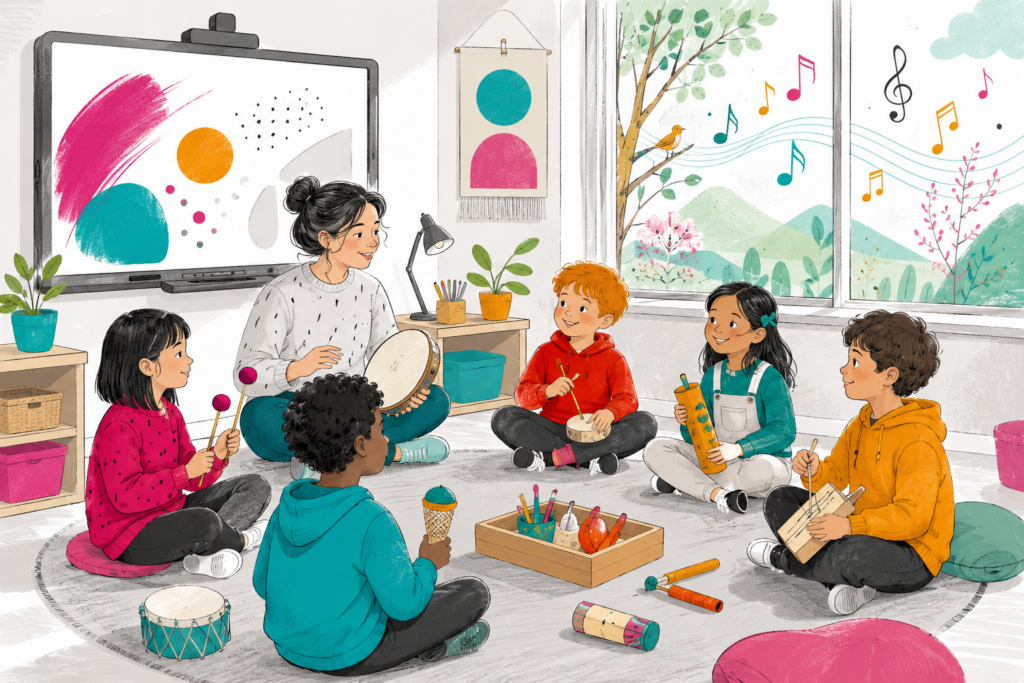
Children and their teacher explore rhythm and sound through playful musical activities, generated by AI.
Sound and motivation
Children learn best when they feel emotionally engaged. Sound, rhythm, music, and storytelling can create positive emotions and encourage participation.
Think about how children react when you sing a familiar song or add sound effects to a story. Sound makes activities playful and interactive. It creates curiosity and encourages children to communicate.
Many children feel more confident when learning through rhythm and movement. This is especially helpful for children who may feel anxious during traditional language activities.
You can increase motivation by:
- using songs during transitions,
- adding sound effects to stories,
- allowing children to create their own sounds,
- combining movement with rhythm,
- encouraging collaborative sound games.
When children actively participate, they become more confident learners.
Sound and memory
Sound also supports memory. Rhythm, repetition, rhyme, and melody help the brain organise and store information more effectively.
Children often remember songs, rhymes, or chants after hearing them only a few times. This happens because sound patterns strengthen memory connections. For this reason, teachers frequently use songs to teach numbers, vocabulary, colours, or classroom routines.
Storytelling with sound can also improve memory and understanding. When children hear environmental sounds, music, or expressive narration during a story, they become emotionally connected to the learning experience. Emotional engagement helps children remember information for longer.
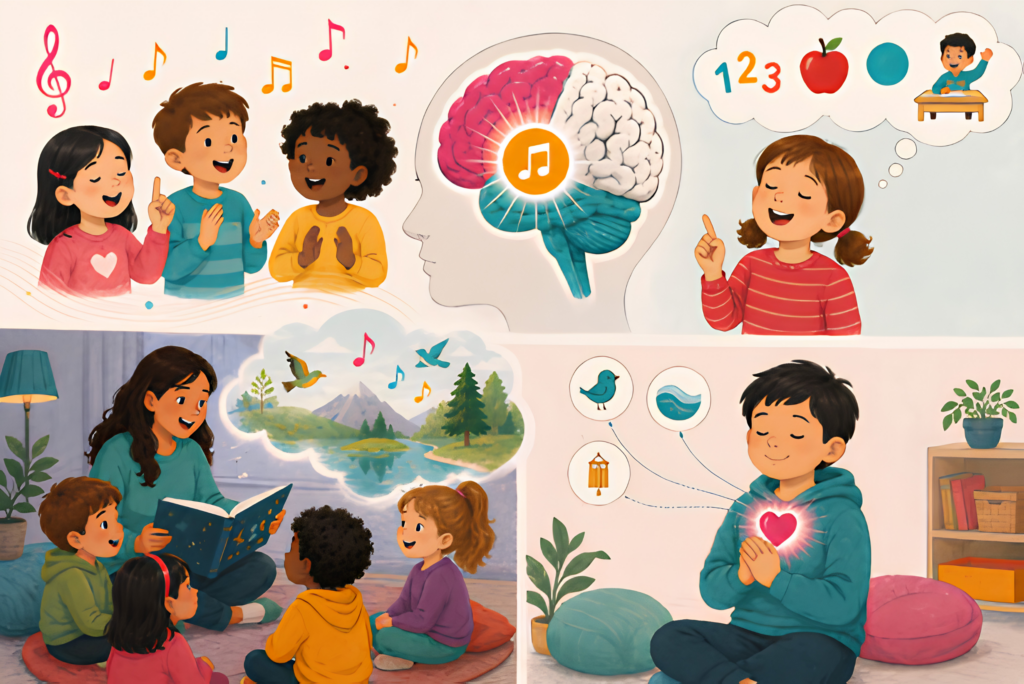
Sounds support children’s memory, generated by AI.
Inclusive learning through sound
Sound-based learning supports inclusion because it offers different ways to access information. Some children learn better through listening, movement, repetition, or multisensory experiences.
Children with Specific Learning Difficulties (SLDs), attention difficulties, speech and language challenges, or disabilities may benefit from sound-supported activities because these methods reduce pressure and increase participation.
Simple multisensory strategies can include:
- combining sound with movement,
- using visual and auditory instructions together,
- repeating key information rhythmically,
- allowing children to respond through sound and movement.
When you use sound creatively, you support communication, confidence, participation, and literacy development for all learners.
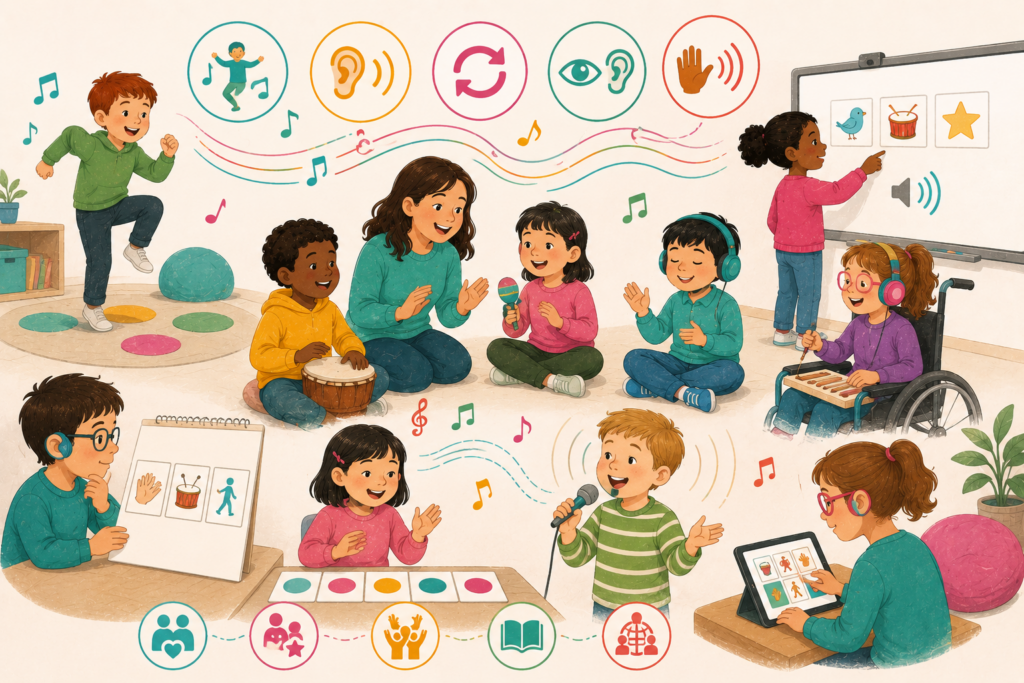
Sounds-based learning supports children with Specific Learning Difficulties (SLDs), generated by AI.
Key outcomes
- Understand how sound supports children’s attention and concentration.
- Recognise the connection between sound, motivation, and emotional engagement.
- Explore how rhythm and repetition strengthen memory.
- Identify inclusive sound-based teaching strategies.
- Gain practical ideas for using sound in everyday classroom activities.
Resources
- Bonacina, S., Huang, S., White-Schwoch, T., Krizman, J., Nicol, T., & Kraus, N. (2021). Rhythm, reading, and sound processing in the brain in preschool children. NPJ science of learning, 6(1), 20.
- Sousa, J., Martins, M., Torres, N., Castro, S. L., & Silva, S. (2022). Rhythm but not melody processing helps reading via phonological awareness and phonological memory. Scientific reports, 12(1), 13224.
- Patscheke, H., Degé, F., & Schwarzer, G. (2019). The effects of training in rhythm and pitch on phonological awareness in four-to six-year-old children. Psychology of Music, 47(3), 376-391.


