
Accelerated Language & Literacy Acquisition
The human brain processes the statistical patterns and regularities of language and music through overlapping neural pathways. For children aged 3 to 8, sound-based training serves as a “whole-brain workout” that sharpens the auditory processing system.
Phonological Awareness: Before a child can read print, they must distinguish fine acoustic changes in speech. Early musical or sound-making experiences accelerate a child’s ability to encode linguistic sound, directly enhancing early reading fluency and letter-sound identification.
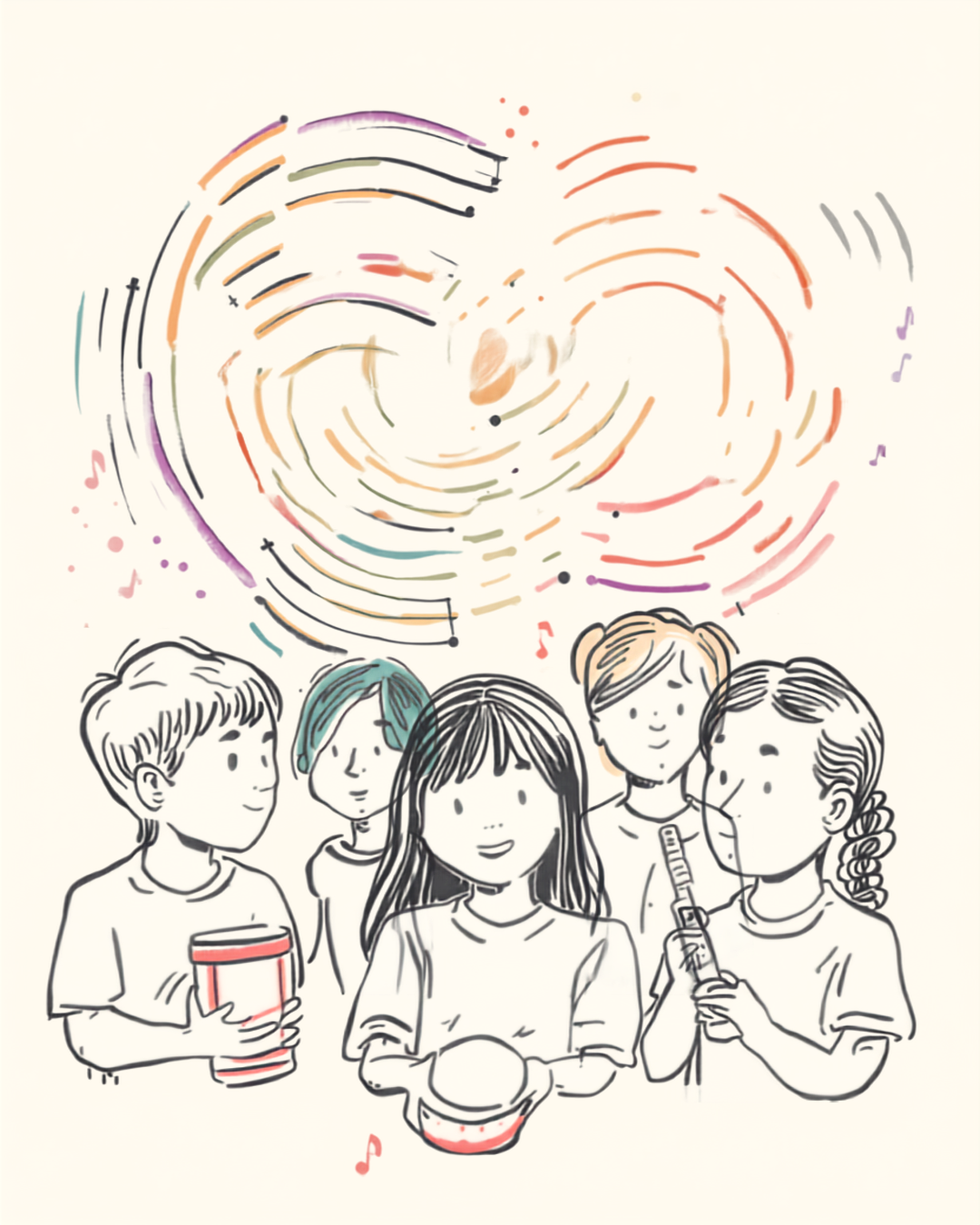
Image generated by AI.
Sensory Integration & Multisensory Processing
Young children are inherently multimodal learners. Engaging with sound forces the simultaneous coordination of three main brain regions: the motor cortex (striking a container, moving to a rhythm), the visual cortex (matching a sound to an object or picture), and the auditory cortex. This multisensory stimulation creates a richer, more lasting cognitive map of the concept being taught.
Enhanced Socio-Emotional Expression
Sound provides a crucial non-verbal avenue for self-regulation and emotional expression. Children who struggle to find the precise words to express anxiety, frustration, or joy can easily communicate those abstractions through the volume, speed, or texture of sound-making tools.
The Power of Interdisciplinary Sound Projects
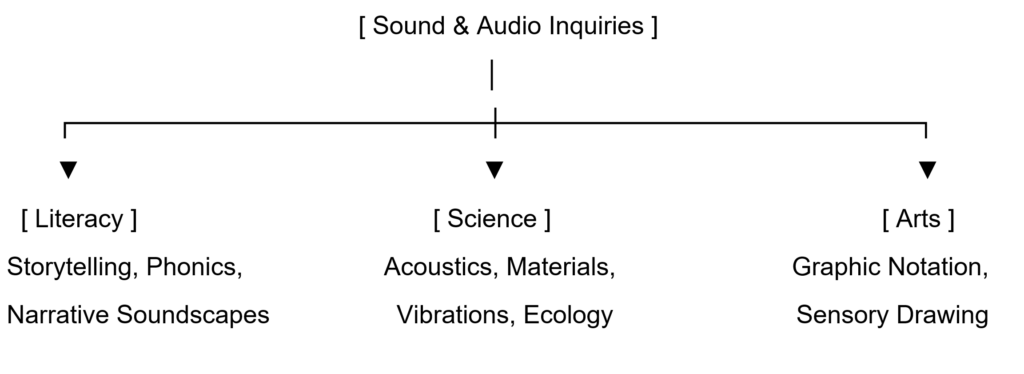
When sound is treated as a collaborative element rather than an isolated subject (like traditional music classes), it transforms into a unifying pedagogical tool.
Sound as a Narrative Bridge (Literacy + Sound)
Interdisciplinary audio work, such as “soundwriting” or oral storytelling, transforms children from passive consumers into active, professional-minded “media storytellers” (Droumeva, n.d.). When a child constructs a soundscape for a story, they analyze the narrative’s mood, structure, and pacing, building deep text comprehension without relying strictly on written words.
Developing “Eco-Listening” (Science + Sound)
Integrating sound with environmental education or physics introduces young children to concepts like material density, vibrations, and acoustics (Marín-Liébana, n.d.). Activities such as “soundwalks” or analysing the sonic landscape of a classroom teach children to recognise the “agentic” power of everyday sounds and their connection to the natural world (Agarwal, n.d.).
1 example of a simple activity (Literacy): The teacher reads a page of the chosen book. The character is walking through a stormy forest.
2 example of a simple activity(STEM/Physics): Ask the children: “What does a storm sound like? How can we make that sound with our bodies or the Sound Box?”
- Younger kids (3-5): Rub hands together to make wind; stomp feet for thunder.
- Older kids (6-8): Experiment with materials. (e.g., “Does crinkling this plastic wrap sound more like rain or fire? Why?”)
3 example of a simple activity (The Interdisciplinary Sync): Reread the page, but this time, the children act as the “Foley artists” (sound effects team), performing the soundtrack live as the teacher reads.
Key outcomes
- Strengthened language and early literacy skillsthrough improved phonological awareness and auditory processing.
- Enhanced multisensory learningby combining sound, movement, and visual experiences.
- Improved emotional expression and self-regulationthrough creative sound-making.
- Supported interdisciplinary learning by connecting literacy, science, and the arts through sound-based activities.
Resources
- Agarwal, M. (n.d.). Soundfullness in early childhood education: An ecological sound art inquiry with educators and children (Unpublished master’s thesis). Western University Open Repository.
- Charalambous, C., & Yerosimou, M. (2020). Drama, music and media in heritage language learning. Journal of Education Culture and Society, 6(2), 370–381.
- Droumeva, M. (n.d.). A pedagogy of listening: Composing with/in media texts. In Soundwriting Pedagogies. Computers and Composition Digital Press.
- Farrell, K. (n.d.). Using guided play to acquire literacy skills (Unpublished master’s thesis). NWCommons.
- Marín-Liébana, P. (n.d.). Sonic education in elementary school: Presence and pedagogical approaches to soundscapes in music textbooks. Frontiers in Education.
- Newman, S. (n.d.). Closing the literacy gap with early years music. TeachingTimes.
- Pino, M. C., Giancola, M., & D’Amico, S. (2023). The association between music and language in children: A state-of-the-art review. Children, 10(5), 801.
- Ravshanovich, K. K. (n.d.). Interdisciplinary connections in music lessons. Progressive Academic Publishing.
- Ruokonen, I., Tervaniemi, M., & Reunamo, J. (2021). The significance of music in early childhood education and care of toddlers in Finland: An extensive observational study. Music Education Research, 23(5), 634–646.
- van As, A. J. (n.d.). Strengthening early childhood teacher education towards a play-based pedagogical approach. South African Journal of Childhood Education.


