
Language development has its milestones, indicating what a child should be able to express and understand at what age. For example, a newborn regards the face and cries. At the age of three months, they smile when spoken to, differentiate cries, and make vowel-like sounds. Around 12 months old, a baby follows simple commands using gestures, says their first words, and begins to have their own jargon. [1]
However, some kids will experience language delays caused by multiple, varied factors. They might have hearing or cognitive impairments, be neurodiverse, or not have developed a speech apparatus.
Each observed and diagnosed speech delay requires a specialist approach under the professional guidance of a speech therapist or other relevant professional. The therapeutic approach should be individual for each child.
In this lesson, we want to share an example showing how music and sound can contribute to the development of kids with language delays.
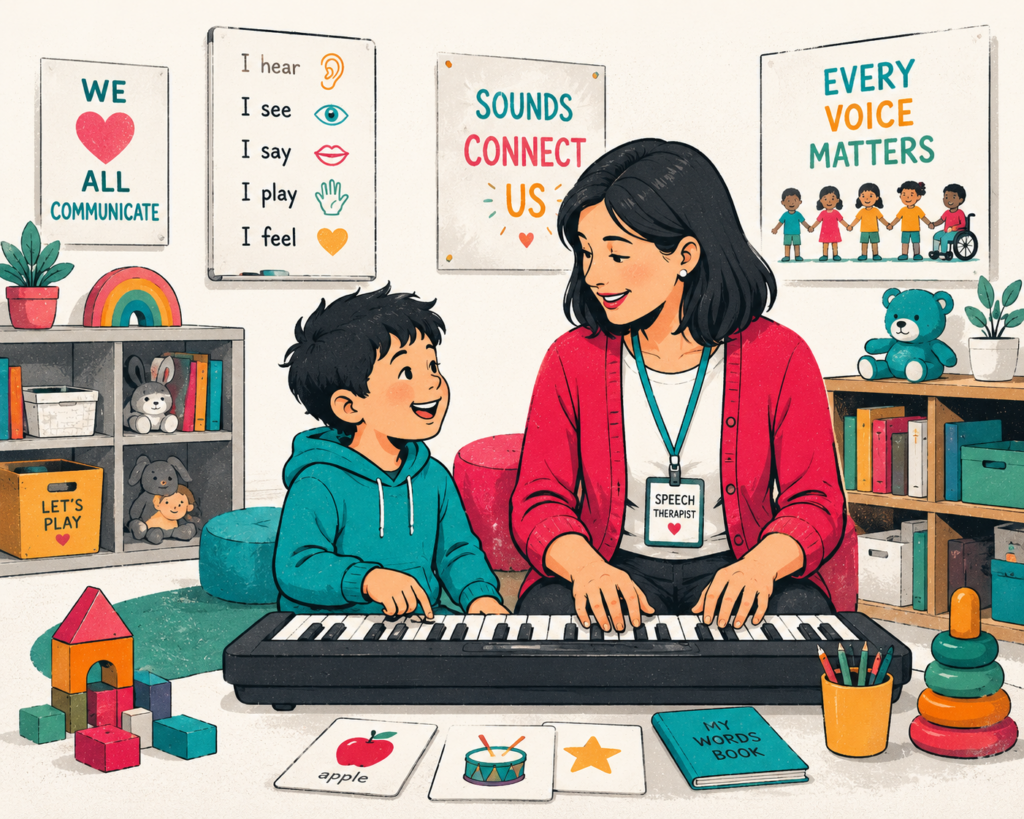
1 A teacher and preschool boy play together on the keyboard. Image generated by AI.
Improvisational Music Therapy (IMT) [2]
Lukas is a few-year-old boy from the Czech Republic living in a city with his family and one sibling. At the age of 3 years and 9 months, following parents’ concern about his non-standard development, especially in speech, he was diagnosed with ASD. At the age of 4 years and 5 months, Lukas started attending a special preschool. Although he understood simple instructions, he didn’t use verbal expression. Zuzanna Vlachová, the researcher-therapist, observed Lukas over 20 sessions during the school year, with a 30-minute intervention per week. The goal was to investigate the influence of an IMT intervention on the SI of a preschool child with ASD in a fixed number of sessions in a qualitative paradigm. [3] The IMT sessions consisted of using musical instruments, like a keyboard, singing, imitating sounds and instruments, vocal dialogues, etc.
Over the year, Lukas’s non-verbal communication expanded. He started using new facial expressions and experimenting with them. The child started making more eye contact and maintained it for longer periods. With the IMT’s progression, the boy stayed focused for longer periods and shared the attention with the researcher-therapist. Overall, Lukas’s non-verbal communication shows efforts to create a relationship, self-awareness and awareness of others, and of sharing in all the observed categories. [4]
This example clearly shows that even if a child will not master their verbal communication skills, they can develop a clear non-verbal communication supported by means fitting their needs, among which music-related methods can be included.
Key outcomes
- Language development milestones help identify delays that may need specialist support.
- Music and sound-based methods, like IMT, can support children with language delays.
- Progress may mean stronger non-verbal communication, not just mastering spoken words.
Resources
- [1] Examples provided after: https://pmc.ncbi.nlm.nih.gov/articles/PMC7236655/
- [2] Parahraph written based on publication Vlachová, Z. (2022) “Means of Musical Dialogues and Reciprocity: Improvisational Music Therapy for Social Interaction of a Preschool Child with Autism Spectrum Disorder”, Voices: A World Forum for Music Therapy, 22(2). doi: 10.15845/voices.v22i2.3191.
- [3] Vlachová, Z., op. cit., p. 10
- [4] Vlachová, Z., op. cit., p. 14


