

Language development
Children’s language development, including their ability to communicate, is of great importance. It is crucial for their ability to express themselves, to participate in communities, and to form relationships. It is essential to their personal growth, development, and well-being. It is essential to their ability to acquire knowledge and, thus, influences how they perform in the long term in school and in life.
Language interactions
Children can develop these abilities and competencies through interactions with adults and by socialising with other children. Likewise, adult role models, including both parents and educators, can support children’s communicative and linguistic development.
Interactions with adults
If you want to help children develop their linguistic competencies, you have to communicate with them as frequently as possible and vary this communication (for example, reading books on different themes, visiting different places like parks, zoos, museums, etc.). Through this process, children are exposed to a variety of words across different contexts and learn their synonyms, which contributes to the expansion of their vocabulary.
This aspect particularly strengthens children’s vocabulary and grammar. This is particularly important for children from families where language exposure is more limited.
Interactions with other children
Language is a key factor in being able to interact with other children. At the same time, these interactions provide opportunities to develop language skills through interaction with others. This particularly enhances their pragmatic language, the language they use in everyday situations.
You can clearly notice the difference in a child’s vocabulary, including less polite words, once they start daycare and again when they begin school.
The role of educators and teachers
As a professional, you can help support and develop children’s communication skills, so they are able to talk about feelings, disagreements, and thoughts, and to discuss these with others. You can foster children’s language development throughout everyday routines, in addition to planned instructional activities.
Talking about sounds can help develop children’s ability to engage in conversations and to understand abstract concepts.
Rhymes and chants
When you work with rhymes and chants with children, you create opportunities for them to play with words and their sounds. This sharpens children’s awareness of individual sounds and the rhymes in letters and word endings. This gives children particular attention to language. At the same time, it encourages them to experiment with new sounds and rhymes.
Chants have a rhythm in the language that causes children to naturally pronounce words more clearly. It also enhances their sense of rhythm and their attention.
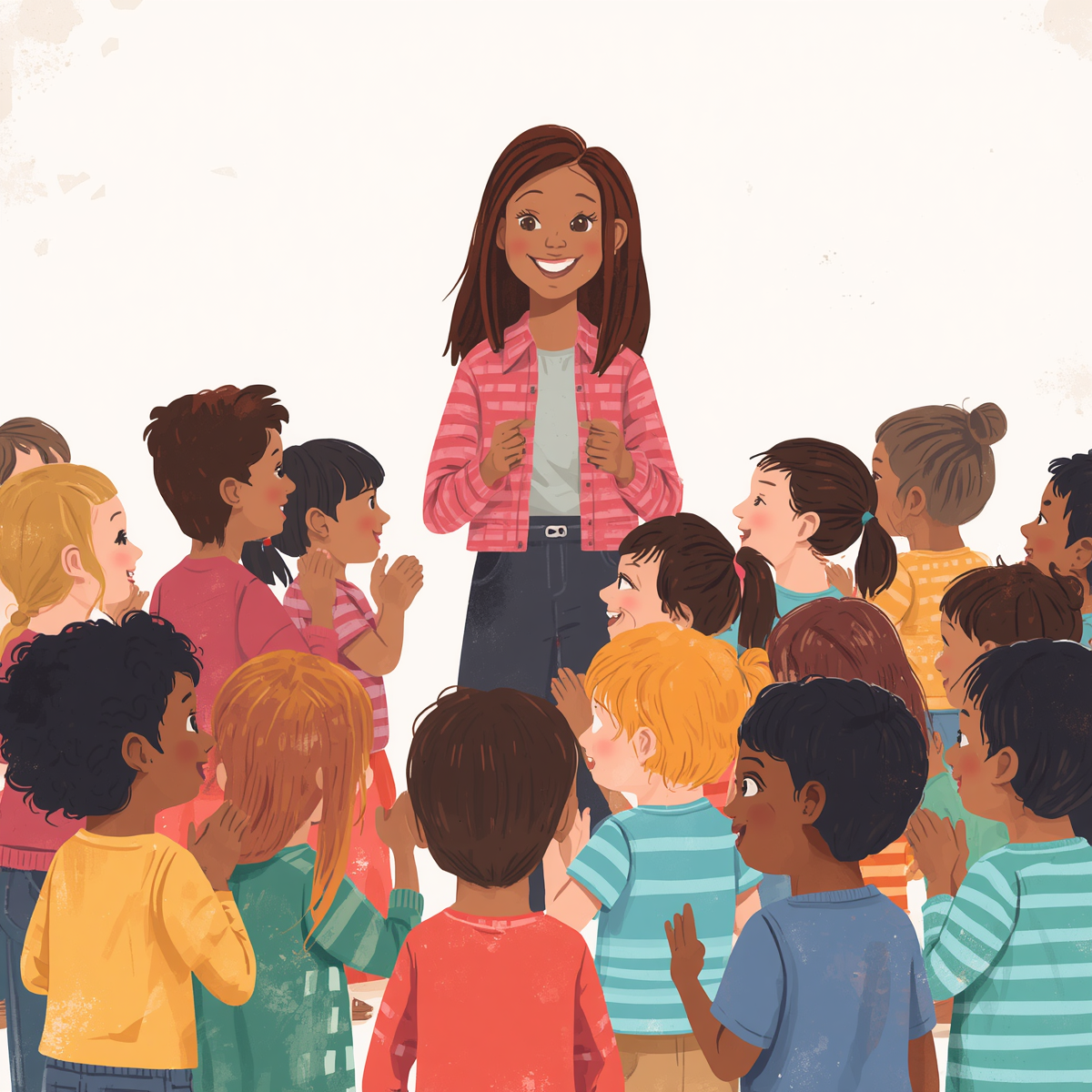
Teacher and children singing and clapping, generated with AI
Key outcomes
- Communication and language are central to children’s well-being, learning, development, and education, both now and in the long term.
- Children learn language through interactions with adults and other children.
- Rhymes and chants strengthen children’s understanding and use of language.
References
- ”Kommunikation og sprog” fra Danmarks Evalueringsinstitut om læreplanstemaer i danske daginstitutioner. (2018-20)
- https://www.laesesporet.dk/lotte-salling-derfor-skal-du-rime-og-remse-med-dit-barn De danske bibliotekers sprog og læsespor Accessed on 25.03.2026


