
Types of sound-based activities for literacy: recording
Introduction
Sound-based literacy activities can also support students in developing listening comprehension, speaking confidence, and creative language use. Recording activities are especially effective because students can hear, evaluate, and improve their own language production.
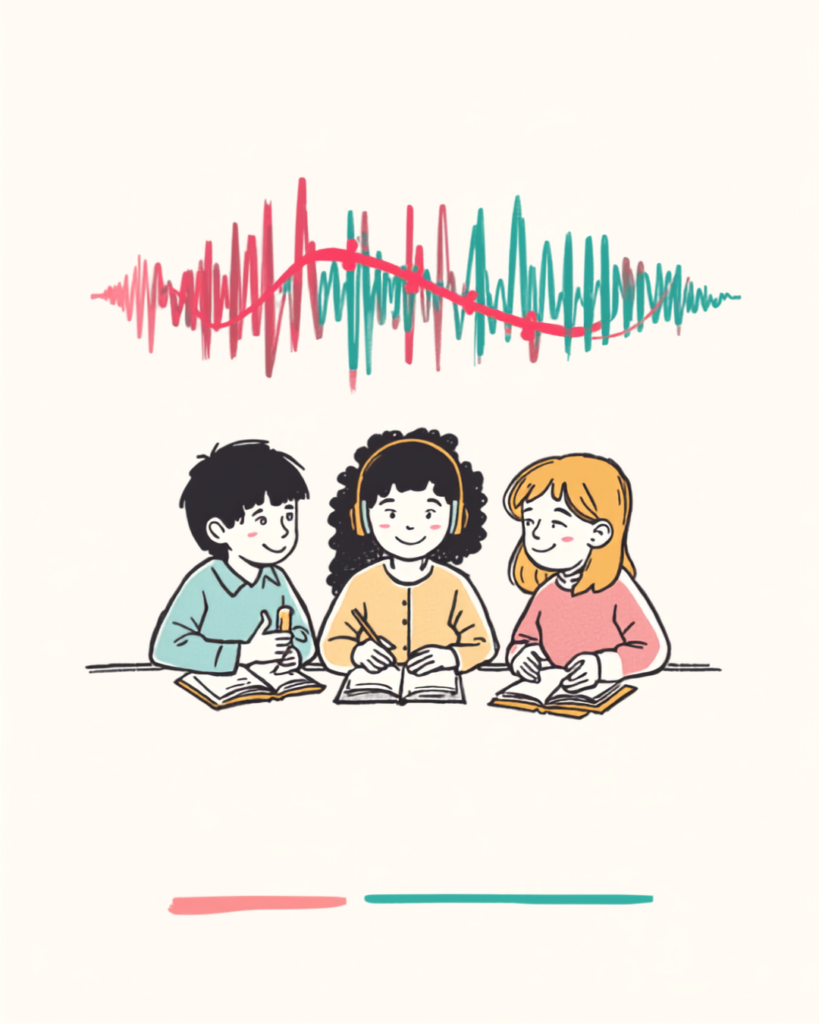
Image generated by AI.
Activity: Reading and Recording a Short Sentence
This activity took place during a literacy lesson with a group of Year 1 students (6–7 years old). The lesson lasted approximately 30 minutes and focused on developing early reading fluency, pronunciation, and listening skills. The students were familiar with the target sounds and high-frequency sight words used in the sentences.
Procedure
The teacher prepared several short sentences containing familiar sounds and sight words, for example:
- “Sam has a mouse.”
- “Mia sees the sun.”
- “The monkey sits on the mat.”
The teacher first read each sentence aloud, modelling correct pronunciation, expression, and pacing. The students then repeated the sentence before recording their own voices using a tablet, mobile phone, or microphone.
After recording, each student listened to their recording and reflected on their reading. The teacher, classmates, or a parent then provided constructive feedback by considering questions such as:
- Was the sentence clear?
- Were the words pronounced correctly?
- Was the reading smooth and understandable?
Purpose of the Activity
The activity was designed to:
- develop listening and speaking skills,
- improve pronunciation and reading fluency,
- strengthen reading confidence,
- increase awareness of sentence rhythm and sound patterns, and
- encourage self-assessment through recording and listening.
Possible Variations
The activity could also be adapted in several ways:
- Students could record short dialogues in pairs.
- Students could create their own sentences using the target sounds.
- Students could add sound effects to make the recordings more engaging.
- Students could record the same sentence twice and compare their progress.
- Each student could record one sentence to create a collaborative class audio story.
Reflection
The students responded positively to the recording activity and were highly engaged throughout the lesson. Listening to their own recordings helped them become more aware of their pronunciation, pace, and clarity. Many students demonstrated greater confidence during their second reading after receiving feedback. Peer discussions also encouraged active listening and respectful communication. Overall, the activity effectively supported the development of reading fluency, oral language skills, and self-confidence while providing opportunities for meaningful reflection on learning.
Why does it work?
Recording activities help students become more aware of:
- Their pronunciation and fluency
- Sentence rhythm and intonation
- Common speaking mistakes
- The connection between written words and spoken language
Students are often highly motivated when using technology and hearing their own recordings. The activity also creates opportunities for collaboration, feedback, and reflective learning.
Key outcomes
- Improved phonological awareness and pronunciation skills
- Increased confidence in speaking and reading aloud
- Better listening and self-reflection through recordings
- Stronger connection between written words and spoken language
- Enhanced collaboration through peer feedback and partner activities
Resources
- Elżbieta Awramiuk(2006).Lingwistyczne podstawy początkowej nauki czytania i pisania po polsku. Białystok: Trans Humana.
- Marta Łockiewicz&Nina Ciecholewska (2017). Phonological processing and reading in a semi-transparent orthography (Polish). L1-Educational Studies in Language and Literature, 17, 1–13.
- Alicja Maurer(Ed.). (2017).Dźwięki mowy: program kształtowania świadomości fonologicznej dla dzieci przedszkolnych i szkolnych. Kraków: Oficyna Wydawnicza Impuls.


