
Introduction
It is a natural thing that each person, including little children, learns things at their own pace. Despite development milestones, some kids simply learn to speak faster than their peers. These differences become more visible when a child enters (pre)school and has more contact with other kids. The diversity in language development is very common. There’s no single ‘correct’ pattern according to which a child should learn to speak. Behind each existing language and dialect stand different forms of communication, culture, and norms. Despite this, some children will have to overcome barriers related to speech itself, their individual features or environmental factors.
The first thought
When we start wondering what might be barriers in children’s differences and barriers in language development, our thinking naturally goes to features such as hearing impairment, neurodiversity, and cognitive disabilities, or, not visible yet at this stage, special learning disorders or disabilities. The challenges those children face may require specialist intervention as soon as they are diagnosed. But there are several, less evident ‘language gaps’ worth our attention.
30 million word gap theory
This theory was groundbreaking when published in the 1990s by Betty Hart and Todd Risley. Nowadays it is considered controversial. The researchers discovered that by age 3, children in welfare families had a vocabulary of 525 words, while those in upper-socioeconomic-status families had 1116 words. They also suggested the reason for this difference: welfare children heard, on average, 616 words per hour, while professional-family children – 2153, resulting in the 30-million-word gap. In other words, children from rich families have a rich vocabulary, poor children have a poor vocabulary.
Since the theory was published, many studies have been conducted, using different methodologies. The more research conducted, the more evidence there is that neither money nor parents’ university degrees determines a child’s language development.
Language – much more than words
Putting aside all controversies, knowing a certain number of words is not everything in early language learning. One has to learn their meanings, use them in sentences, and express one’s thoughts, feelings, and emotions with them. At the same time, we have to remember that language is much more than only words. It is a […] semiotic process that involves sound, touch and gestures […] [1]. Each language and dialect is also a very important part of culture – it has its own cultural background, codes, between-the-lines meanings, and ways of addressing different people. This leads us to conclude that within a country or even a community, children can develop their language skills through diverse patterns and strategies.
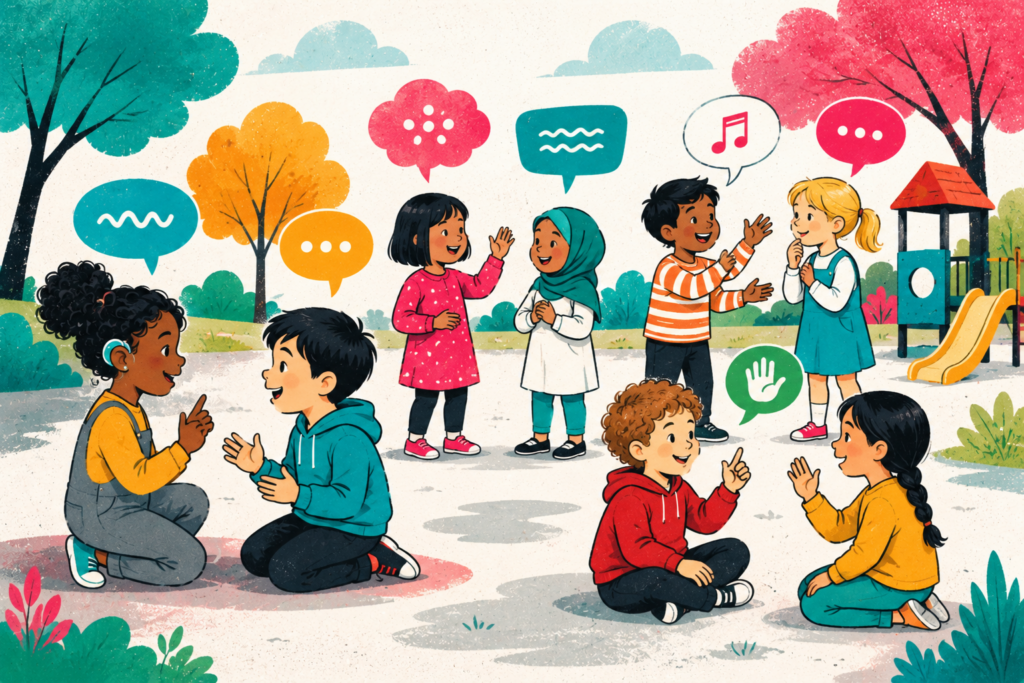
1 Pre-school children playing outdoors and communicating in different ways.
Multilingualism
According to EU statistics, on average 11,5% of EU students aged 15 speak a different language at home than the one at school […] [2]. Although the data refer to teenagers, they show that multilingualism is present in schools across Europe.
Entering the (pre)school environment, especially at ages 3–5, without any knowledge of the language used there and without proper support can be one of the biggest barriers to developing skills in both home- and school-spoken languages. When children don’t understand what teachers say, they can’t follow their instructions and curriculum. When they don’t understand what their peers say, it will be challenging for them to build social relations. Studies show that those children may face difficulties in later years of education in achieving the same results as their peers who use the same language at home and at school. Over the years, several educational strategies have been developed to equalise the chances of non-native-speaker (pre)school attendees. The most efficient one is called mother-tongue-based multilingual education (MTBMLE). Its core is to teach children in their mother tongue for the first years of school, introduce a second language, and then continue bilingual education [3].
Difficult sounds
Even learning a mother tongue might be challenging for a child. They might need support in:
- learning correct articulation – how to pronounce words
- mastering fluency – smoothness of expression
- voice and resonance quality – its strength and volume.
We recommend you take a look at resources explaining in detail the milestones children should achieve in their language development and the ages at which they should occur. [4]
How to support kids?
It is not possible to introduce bilingual education or address all, sometimes complex, language barriers just like that. This requires changes on the national level. Sometimes, for various reasons, we’re not even aware of kids’ language struggles. Overcrowded classes and a lack of staff make an individualised approach very difficult to implement.
But it doesn’t mean that we, as teachers and educators, should give up. Inclusion means giving children support in both the language of schooling and, where possible, their home language, so that every child can take part and learn.
We can introduce methods into our learning practices, such as sound-based learning, visual support, storytelling, and repetition, that engage multiple senses, allowing kids to express themselves and build strong language foundations from the start. In the next modules of this online course, we’ll take a closer look at how you can use sound-based learning in your classroom, and how it supports children’s language development.
Key outcomes
- Language development varies by culture and background – no single pattern is “correct.”
- Multilingualism becomes a natural part of (pre)school environment
- Teachers and educators can use multi-sensory methods to support every child’s language development
Resources
Footnotes
- [1] Word Gap, in: Wikipedia, accessed on 7 May 2026.
- [2] New Eurobarometer shows Europeans’ positive attitude towards language learning, press release 21 May 2024, accessed on 7 May 2026. There are no similar statistics for younger students. But even these data show that multilingualism is strongly present in the learning environment. In certain countries, the rate of students who speak different languages at home and at school exceeds 20%, cf. European Commission: European Education and Culture Executive Agency, Key data on teaching languages at school in Europe – 2023 edition, Birch, P.(editor), Publications Office of the European Union, 2023, Fig. A2, p. 33, accessed on 7 May 2026.
- [3] For details about MTBMLE, see: H. Pinnock, Steps Towards Learning A guide to overcoming language barriers in children’s education, 2009, accessed on 7 May 2026.
- [4] See, for example, Speech and language development between ages 3 and 5, 14 August 2024, accessed on 7 May 2026; Feldman H.M., How Young Children Learn Language and Speech, Pediatr Rev. 2019 Aug; 40(8):398-411, doi: 10.1542/pir.2017-0325, accessed on 7 May 2026.
Bibliography
- ‘Word Gap’, Wikipedia, accessed 8 May 2026.
- SickKids Staff, ‘Speech and Language: How to Help with Articulation’, AboutKidsHealth, last updated 21 January 2025, accessed 8 May 2026.
- SickKids Staff, ‘Speech and Language Development between Ages 3 and 5’, AboutKidsHealth, last updated 14 August 2024, accessed 8 May 2026.
- European Commission, ‘New Eurobarometer Shows Europeans’ Positive Attitude towards Language Learning’, Press Corner, 2024, accessed 8 May 2026.
- Turner, C., ‘Let’s Stop Talking about the 30 Million Word Gap‘, NPR Ed, 1 June 2018, accessed 8 May 2026.


