

Bilingualism
A bilingual person is someone who uses two or more languages in their daily life, regardless of their level of proficiency. [1] Bilingual learners are typically more proficient in understanding their second language than in speaking it, particularly during the early stages of language acquisition. Similarly, their ability to understand language is often more advanced than their ability to express themselves verbally. It can therefore be said that they possess both an active and a passive language repertoire. The passive repertoire can also include gestures, facial expressions, and vocalisations.
Culture
Some bilingual individuals may also experience having to relate to a new culture while learning a new language. It is important to approach this as adding an extra language, rather than replacing their native language.
The role of educators and teachers
The first language plays an important role in multilingual learners’ acquisition of a new language. As a professional, you can strengthen the children’s connection with their first language by encouraging them to share words in their native language as they learn new ones.
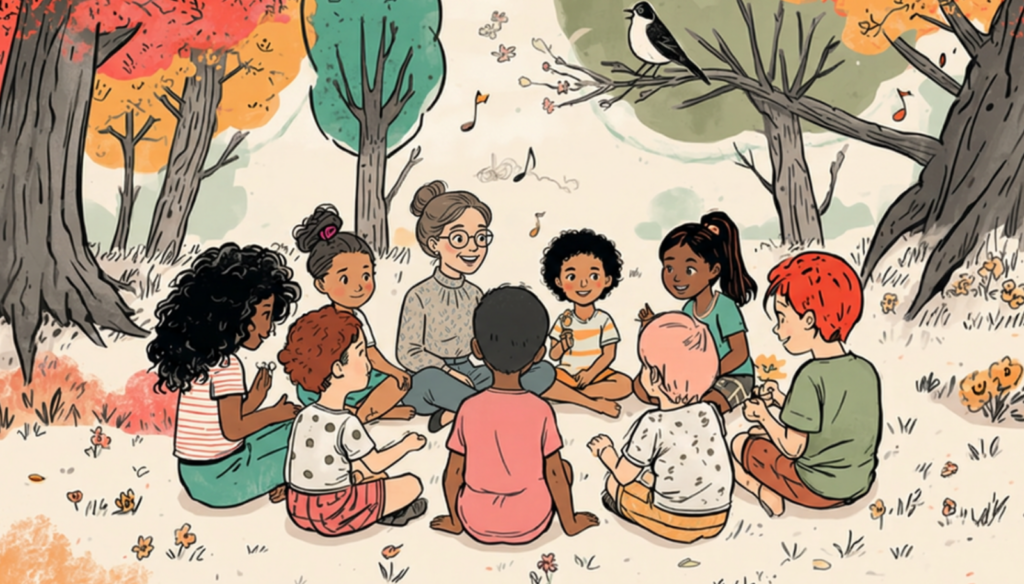
Teacher and children talking, generated with Canva AI
As in all teaching, it is important to foster a culture where children are not afraid of making mistakes but feel confident to try. You can support this by highlighting diversity as a strength amongst the children and by not being afraid to make mistakes yourself. It is important that you support children in turning their passive language skills into active ones, so they can use the language rather than just understand it.
Rhymes and chants
Rhymes and chants give children the opportunity to play with words and their sounds. This sharpens their awareness of individual sounds and words. This gives children a particular sensitivity to language. At the same time, it encourages children to experiment with new sounds and words.
Music and songs, words and sounds
Music and rhythm make it easier to remember sounds and words. Sounds and images can help support children’s ability to expand their vocabulary. You can make use of this by supporting the stories you read or tell with pictures and sounds – for example showing a cow and playing its sound when teaching the word ‘cow’. In this way, you can help create a network of associations that supports children’s language and conceptual understanding. Introducing topics such as animals, sports, or historical periods allows you to connect new learning to bilingual children’s previous experiences and background knowledge. By using sounds to introduce a topic or a story, you can help to activate the children’s prior knowledge.
Key outcomes
- Bilingual children often have a larger passive vocabulary than active vocabulary, and it is the educator’s role to support the child in making that passive vocabulary usable.
- It is important to foster a positive culture that highlights differences as a strength.
- Rhymes and chants strengthen children become more aware of sounds and words.
- Sounds can help create a network of associations.
Resources
- Servicestyrelsen, ”Tosprogede børn i dagtilbud” https://emu.dk/sites/default/files/2019-03/Tosprogede%20-%20tekst.pdf
- [1] Den Store Danske, ‘Tosprogethed’, lex.dk – Den Store Danske, accessed 23 June 2026.


