
Every child learns differently. Some children learn best through listening, others through movement, visuals, repetition, or hands-on experiences. Inclusive early literacy education recognises these differences and creates learning environments where all children feel supported, respected, and able to participate.
Sound-based learning can help teachers create more inclusive and diverse literacy experiences because sound naturally connects communication, emotion, creativity, and interaction. Through stories, rhythm, music, listening, and sound exploration, children can participate in learning using different strengths and abilities.
In early childhood classrooms, diversity may include:
- different languages,
- cultural backgrounds,
- learning styles,
- communication needs,
- abilities and disabilities,
- social and emotional differences.
Inclusive teaching means creating opportunities for every child to feel involved and valued.
Why sound supports inclusion
Sound-based activities often reduce pressure and encourage participation in playful ways. Children can respond through:
- listening,
- movement,
- rhythm,
- sound imitation,
- storytelling,
- singing,
- collaborative games.
These activities allow children to communicate even if they are not yet confident readers or speakers.
For example, children with Specific Learning Difficulties (SLDs), speech and language difficulties, autism, attention deficit disorders, or limited vocabulary may feel more comfortable participating through rhythm, sound effects, gestures, or recorded voices.
Sound also supports multilingual classrooms. Children can explore sounds, songs, and stories from different languages and cultures. This helps create respect for diversity and encourages curiosity about different ways of communicating.
Creating inclusive literacy experiences
As a teacher, you can make small adjustments that support inclusion during sound-based activities.
For example:
- use a clear structure
- repeat important information,
- combine sound with visuals,
- allow movement during activities,
- provide extra response time,
- encourage pair and group work,
- create predictable routines.
You can also offer children different ways to participate.
Some children may:
- speak,
- point,
- move,
- clap rhythms,
- use pictures,
- record sounds,
- create sound effects.
All responses are valuable forms of communication.
Sound and emotional safety
Children learn best when they feel emotionally safe. Sound-based learning can create calm, playful, and supportive classroom environments.
Soft music, rhythm activities, breathing sounds, and storytelling can help children regulate emotions and reduce anxiety. Group sound games also encourage cooperation and social connection.
It is important to remember that some children may be sensitive to loud or unexpected sounds. Observe children’s reactions and create flexible activities where everyone feels comfortable.
Celebrating diversity through sound
Sound and storytelling can help children discover different cultures, traditions, and experiences.
You can include:
- songs from different countries,
- multilingual stories,
- environmental sounds from different places,
- traditional instruments,
- cultural rhythm games.
These activities encourage empathy, curiosity, and respect for diversity.
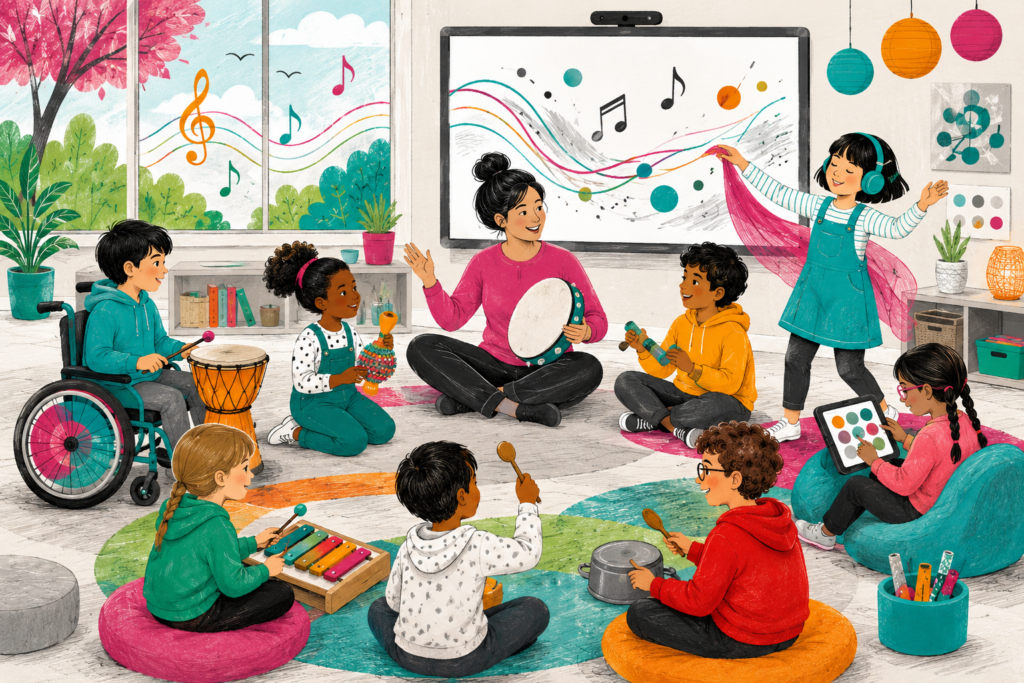
Diverse children and their teacher collaborate through rhythm, movement, and storytelling in a bright, inclusive classroom filled with music, creativity, and visual expression. Generated image with AI.
Answer the sound inclusion quiz in the section “exercise”.
Key outcomes
- Understand how sound-based learning supports inclusion and diversity.
- Explore inclusive literacy strategies for young learners.
- Recognise the importance of multisensory and flexible teaching approaches.
- Identify ways to support communication and participation for all children.
- Develop awareness of cultural diversity through sound and storytelling.
Resources
- Booth, T., & Ainscow, M. (2002). Index for inclusion: developing learning and participation in schools. Centre for Studies on Inclusive Education (CSIE), Rm 2S203 S Block, Frenchay Campus, Coldharbour Lane, Bristol BS16 1QU, United Kingdom, England (24.50 British pounds).
- Florian, L., & Black-Hawkins, K. (2011). Exploring inclusive pedagogy. British educational research journal, 37(5), 813-828.


